26/10/2026 - Blog post
Explosives and narcotics trace detection: how IMS and Raman technology work
Not every threat is visible on an X-ray image. Microscopic traces of explosives on a bag, an unknown white powder in a parcel or a liquid in an unlabelled bottle can only be identified by analysing the substance itself. Trace detection and Raman spectroscopy make that possible within seconds, without opening a laboratory.
Airports, customs, seaports, postal logistics, rail transport and law enforcement use these technologies every day. In this article, we explain how ion mobility spectrometry (IMS) and Raman spectroscopy work, how they differ and when to use which.
What is trace detection?
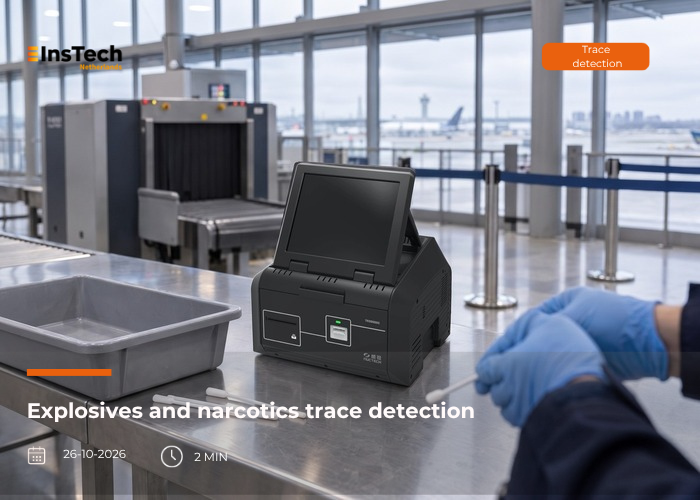
Trace detection looks for particles that are too small to see. An operator wipes a surface, such as a suitcase handle, air cargo, clothing or skin, with a sampling swab. The detector then analyses the swab and raises an alarm if it finds explosives or narcotics.
This makes trace detection a strong addition to X-ray screening. An X-ray scanner shows the shape and density of an object. A trace detector shows whether someone has been handling explosives or drugs, even if nothing suspicious is visible on the image.
How ion mobility spectrometry works
Most trace detectors are based on ion mobility spectrometry. The process takes place in a few steps:
- Heating: the sample is heated, so the molecules turn into vapour.
- Ionisation: an ionisation source gives the molecules an electrical charge.
- Drift: an electric field pulls the ions through a drift tube towards a detector. Their speed depends on their mass, size and charge.
- Identification: each substance arrives at its own moment. The resulting spectrum is compared with a library of known explosives and narcotics.
IMS works at normal air pressure, is highly sensitive and needs only a short analysis time. That is why it is the most practical method for fast trace detection at a checkpoint.
Non-radioactive ionisation: safer and more accurate
Traditional trace detectors use a small radioactive source to ionise the sample. The TR series uses a non-radioactive ionisation source (NRIS) instead, developed by our own R&D teams. This removes the need to handle and manage a radioactive source, and it achieves up to ten times higher detection accuracy than traditional radioactive-based systems.
The TR series includes three models for different situations:
- TR2000DC: a desktop detector for checkpoints. It detects explosives and drugs in one analysis, detects most explosives in five seconds and is ECAC approved for both passenger and cargo screening.
- TR1000QC: a lightweight handheld detector for field use. Besides explosives and drugs, it detects toxic industrial gases and chemical warfare agents, and it includes a radiation detection module.
- TR3000DE: a high-throughput model for landside security and risk assessment.
How Raman spectroscopy identifies unknown substances
Sometimes the question is not whether there are traces, but what a visible substance actually is. That is where Raman spectroscopy comes in.
A Raman spectrometer shines a laser on the substance. Because every molecule has its own structure, the scattered light forms a unique fingerprint. The device compares that fingerprint with its library and identifies the substance. The test is non-destructive, so no sample is consumed.
Our Raman spectrometers identify explosives, narcotics, dangerous liquids, industrial chemicals and precursors in about five seconds. The RT1003EB liquid security inspector can analyse most dangerous materials in various containers.
IMS or Raman: which one do you need?
Both technologies detect explosives and narcotics, but they answer different questions:
- IMS trace detection: finds invisible traces on surfaces. Best suited to high-volume screening of passengers, baggage and air cargo.
- Raman spectroscopy: identifies a visible, unknown powder, liquid or tablet. Best suited to customs, border control and police investigations.
- Combined with X-ray: the scanner flags a suspicious object, trace detection confirms contact with a threat and Raman identifies the exact substance.
This combination is becoming more important. Dutch Customs reports that criminals increasingly hide drugs inside the cargo itself and use chemical concealment, which calls for better detection methods. We describe this development in our article on how container and vehicle inspection strengthens port security.
Where trace detection is used
Trace detectors from the TR series have been used in civil aviation worldwide for more than a decade. They are just as effective in other environments:
- Aviation: passenger, baggage and air cargo screening.
- Ports and borders: checking vehicles, containers and travellers for drugs and explosives.
- Postal logistics: screening suspicious parcels and letters.
- Law enforcement and judicial security: fast identification of seized substances.
How InsTech Netherlands can help
InsTech Netherlands supplies trace detectors and Raman spectrometers for aviation, customs, ports, public security and industry. With our European headquarters, service team and spare parts warehouse in the Netherlands, we support you from choosing the right system to training your operators and keeping detectors running.
Do you want to strengthen your detection of explosives and narcotics? Contact InsTech Netherlands for advice, a product demo or a tailored solution.