17/07/2026 - Blog post
Deep learning for the detection of hazardous substances in cargo and baggage
In the security industry, advanced technologies are becoming increasingly important for identifying threats quickly and effectively. One of the groundbreaking innovations in this field is the use of deep learning (a subset of artificial intelligence (AI))to detect suspicious substances in cargo and baggage. Deep learning enables the faster and more accurate identification of hazardous substances, such as explosives, drugs, and weapons, than ever before. But how does this technology work exactly, and why is it so powerful for security purposes?
What is deep learning and how is It spplied in security?
Deep learning is a form of machine learning, where computer systems are trained to independently recognize patterns and features in large amounts of data. The system learns from example data, such as images from X-ray scanners or CT scanners, and applies this knowledge to identify new, unseen objects or substances.
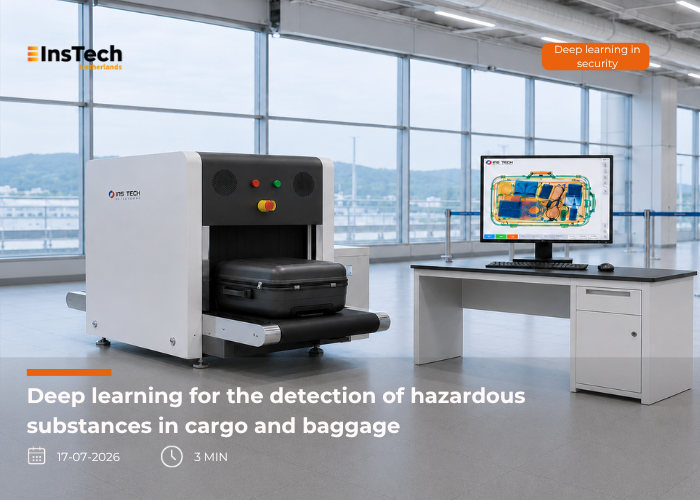
In the context of security screening, deep learning algorithms are used to analyze images of baggage or cargo. These algorithms can be applied to images generated by X-ray scanners, CT scanners, or other imaging technologies. Instead of relying on an operator to manually search for suspicious objects, the deep learning system can automatically scan the images in real-time and flag suspicious substances that may pose a threat.
Deep learning can also be applied to analyzing 3D images, such as those from a CT scan. The system "understands" the structure of the object by examining the density of different materials and can accurately determine which substances might be hazardous.
The technology behind deep learning in security
Deep learning works by using what are called "neural networks." These are computer programs inspired by how the human brain works, with layers of 'neurons' connected to each other. Each layer in the network processes information and passes it to the next layer, which continues the analysis. This process is iterative and allows the system to recognize increasingly complex patterns as it processes more data.
For example, when analyzing an X-ray image of a suitcase, the first layer of the neural network might look for general shapes, while later layers become more specific in identifying materials such as metal, plastic, or possibly dangerous substances like explosives. The system can also learn what typical "normal" items are, such as clothing or electronics, and thus detect anomalies more quickly.
An important feature of deep learning is that the system continually improves itself. Over time, when exposed to more images and data, it becomes better at recognizing new threats, even if they appear in unusual ways. This means that the system is not only effective at detecting known hazardous substances but can also respond to new, yet unknown threats.
Deep learning and the benefits for security screening
Deep learning offers several advantages over traditional security technologies:
Faster Detection: Deep learning algorithms can analyze images in real-time, enabling suspicious substances to be identified immediately. This significantly speeds up the screening process.
Higher Accuracy: Due to deep learning's ability to recognize subtle patterns, even well-hidden hazardous substances can be detected. This reduces false alarms and results in more reliable screening.
Fewer Human Errors: Traditional systems often rely on human operators who manually inspect images, which can be tiring and error-prone. Deep learning reduces the reliance on human input, decreasing the likelihood of mistakes.
Scalability and Adaptability: Deep learning systems can be easily adjusted and scaled to detect new types of threats as they emerge. This makes the system future-proof and adaptable to the ever-changing nature of security threats.
Application of deep learning in cargo and baggage screening at InsTech Netherlands
At InsTech Netherlands, we are leading the way in integrating deep learning technology into security screening systems. Our advanced systems use deep learning to not only identify suspicious substances in baggage but also detect a wider range of threats in cargo.
Our AI-driven inspection systems combine the power of deep learning with advanced X-ray and CT scanning technologies to scan the contents of baggage and cargo in real-time. These systems can quickly and accurately detect materials like explosives, liquids, or other hazardous substances, even if they are well hidden among other items.
Our systems can also learn from previous scans to continuously improve detection capabilities. Through in-depth training with millions of different example images, the deep learning system develops refined recognition techniques that enhance the effectiveness of the screening process.
In addition, we offer customized solutions for airports, border control, and other security agencies, ensuring that our customers always deploy the most up-to-date and efficient technologies. We make sure our systems are compatible with existing infrastructures, facilitating smooth implementation and transition to these advanced technologies.
The future of deep learning in decurity dcreening
The possibilities for deep learning in security technology continue to grow. As the technology evolves, deep learning systems will become even better at detecting both traditional and emerging forms of danger. This means that the security systems of the future will not only be faster and more effective but also proactively recognize threats before they even manifest.
At InsTech Netherlands, we continue to be at the forefront of developing these technologies. Our deep knowledge of the security industry and the integration of advanced AI solutions enables us to enhance the safety of airports, border control, and other security organizations.
Contact us for a demonstration or to learn more about how our deep learning solutions can improve your security systems.