30/09/2026 - Blog post
Enhancing border control with mobile scanning solutions
Border control operations are becoming increasingly complex. Growing volumes of international trade, changing traffic patterns and evolving security threats require inspection capabilities that can adapt just as quickly. Permanent inspection facilities remain essential, but they are not always available where additional screening capacity is needed.
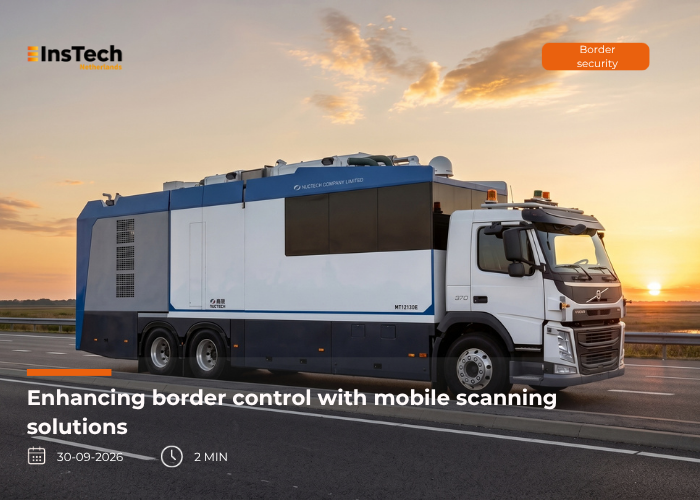
Mobile scanning solutions provide border control agencies with the flexibility to deploy advanced inspection technology exactly where and when it is required. From busy ports and land border crossings to temporary checkpoints, mobile systems make it possible to inspect vehicles and cargo efficiently without depending entirely on fixed infrastructure.
Mobile scanning systems can support border control operations by enabling authorities to:
- Rapidly deploy inspection capacity at temporary or remote locations.
- Respond to changing traffic patterns, including trucks, containers, rail cars and smaller vehicles.
- Increase inspection capacity during periods of higher demand.
- Maintain efficient traffic flows while performing detailed non-intrusive inspections.
- Relocate inspection equipment when operational priorities change.
For example, the mobile vehicle inspection system in our product range combines mobility with advanced scanning capabilities. When folded, the system can be driven like a conventional vehicle. Once positioned at the inspection site, it can be deployed as a complete scanning system.
Key features of our mobile scanning systems
Mobile scanning technology combines advanced inspection capabilities with the flexibility required for dynamic border control environments. Some of the most important features include:
- Flexibility & rapid deployment: The NUCTECH MT6000A is designed for the inspection of heavy vehicles, trucks and containers. The system can retract to approximately the size of a standard 20-foot container and can be prepared for operation at a new location within 30 minutes.
- High throughput: Depending on the configuration and operating conditions, mobile scanning systems can inspect up to 150 units per hour. This helps authorities maintain effective inspections without unnecessarily disrupting traffic flows.
- Material discrimination via dual-energy imaging: The NUCTECH MT1213DE uses dual-energy imaging to differentiate between organic, inorganic and mixed materials. This provides operators with additional information when identifying suspicious cargo, concealed goods or potentially dangerous materials.
- Auxiliary system integration: Mobile systems can be integrated with technologies such as license plate recognition (LPR), container code recognition (CCR), radioactivity monitoring and remote inspection modules. This supports a more connected border control workflow.
How mobile scanning benefits border control operations
Mobile scanning provides more than the ability to move inspection equipment from one location to another. It gives border agencies greater flexibility in deciding where, when and how screening capacity is deployed.
- Deployment where and when you need it: Inspection capacity can be moved to locations where traffic volumes, operational requirements or security risks increase.
- Maintain trade flow: High-speed and drive-through scanning can help minimise delays while maintaining thorough inspection procedures.
- Scalable & future ready: Additional screening capacity can be deployed temporarily during seasonal cargo peaks, major events or emergency situations without immediately requiring permanent infrastructure.
- Support intelligence-led inspections: Mobile systems can be deployed at locations selected based on changing risk profiles or operational intelligence, giving authorities greater flexibility to respond to emerging security concerns.
Real-world applications of mobile scanning in border control
Mobile scanning solutions can support a wide range of border control environments:
- Land border crossings: Supplement permanent inspection infrastructure or provide screening capabilities at locations where fixed scanners are unavailable.
- Ports and cargo terminals: Add inspection capacity when cargo volumes fluctuate or temporary inspection lanes are required.
- Rail and multimodal terminals: Inspect containers, trucks and rail cargo before they continue through the supply chain.
- Temporary checkpoints: Establish additional inspection capabilities for temporary operations, special events or changing security requirements.
- Targeted enforcement operations: Relocate scanning equipment to areas where additional vehicle or cargo inspections are required.
Choosing the right mobile scanning solution
Every border control environment has different inspection requirements. The most suitable mobile scanning system depends on factors such as vehicle type, cargo volume, available space, required throughput and existing inspection technologies.
When selecting a solution, it is important to consider:
- What types of vehicles or cargo need to be inspected?
- How many units need to be processed per hour?
- How frequently will the system need to be relocated?
- Which detection capabilities are required?
- Does the scanner need to integrate with existing border control systems?
By considering these requirements as part of the complete inspection process, border control agencies can select a solution that supports both security objectives and operational efficiency.
Ready to strengthen your border control capability with mobile scanning?
Contact InsTech Netherlands today to learn more about our mobile vehicle and cargo inspection systems and discover how you can enhance security while preserving operational agility.